

Help Your Clients Relocate to Central Texas
What out-of-state home buyers need know before moving to austin
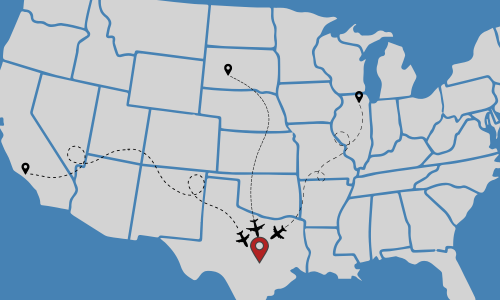
As a Central Texas real estate agent, you know that out-of-state buyers are often shocked by how different our “house health” priorities are. In California, they worry about earthquakes; in the Midwest, it’s basements.
In Texas? It’s all about the Big Three.
To help you manage expectations and keep your deals on track, here is a “Texas Cheat Sheet” for your relocation clients to explain why we prioritize certain residential property inspection items.
1. The home Foundation: It’s Not a Floor, It’s a Sponge
Most relocation buyers think a crack in a slab is a deal-breaker. In Central Texas, our expansive clay soil (the Blackland Prairie) swells when wet and shrinks when dry. The house is designed to "move," but it needs to stay within a safe range.
The Reality: Small "hairline" cracks are often cosmetic, but significant shifting can impact plumbing and structure.
The "Ally" Move: Instead of just a visual check, we use high-precision digital measurement for floor levelness. This gives your buyer hard data—not just a guess—on how the house is performing. Read our case study on foundation movement in Georgetown.
2. The WDI Report: It’s Not If, It’s "When
Many buyers assume termites are only an issue for older, neglected homes. In Central Texas, thanks to our humidity and heat, subterranean termites are a fact of life for everyone from luxury estates to brand-new builds.
The Reality: Termites work from the inside out. By the time you see them, the damage is done.
The "Ally" Move: We prioritize the WDI (Wood Destroying Insect) report. Identifying "conducive conditions"—like high soil grade or wood-to-ground contact—allows your buyer to fix the problem before it becomes a structural disaster.
3. The HVAC: A Life-Support System
In the North, the furnace is the hero. In Texas, the AC is a critical safety system. A unit approaching 12 years of age is effectively a "senior citizen" in our 100°F+ summers.
The Reality: Replacing a system can cost $10k–$15k. We check the "Delta-T" (temperature split) to ensure the system can actually handle a Texas July (and August and September and…).
The "Ally" Move: We look at the HVAC through a safety-first lens, checking for proper drainage and electrical integrity so your buyer isn't surprised by an attic flood or a fire hazard. See our case study on HVAC efficiency from the Mueller neighborhood.
Austin Relocation FAQs
-
Not necessarily. Many Texas homes have minor "settling" cracks that are perfectly stable. However, "differential settlement" (where one side drops significantly) is a concern. We use data to help you decide if you need a structural engineer or if it's just a cosmetic fix.
-
Yes, for the most part. Because of our expansive clay soil and high water table, building deep basements is prohibitively expensive and structurally risky in Central Texas. Instead, we use "Slab-on-Grade" foundations. This is why our foundation elevation surveys are so critical—since there’s no basement to walk into and check for leaks, we have to use specialized equipment to "see" how the slab is performing.
-
Texas standards are strict because our heat is relentless. An HVAC unit might blow cold air today but have a low "Temperature Split" (Delta-T), meaning it’s struggling to keep up with the 100°F+ heat. We flag these early so relocation buyers—who may not be used to $400 electricity bills—know if they are walking into a system that is nearing the end of its life.
-
The Option Period is a uniquely Texas contract feature—usually 5 to 10 days—where the buyer has the unrestricted right to terminate the contract. This is your window for inspections. Because this timeline is so tight for people moving from out of state, we prioritize same-day digital reports with high-def photos so you and your agent can negotiate repairs or credits before the clock runs out.
Final Note for Relocating Buyers
We know out of town homebuyers are often on tight timelines, house hunting on a quick weekend trip or even seeing the home in person for the first time during the inspection. To provide the best customer experience and accommodate all types of schedules, First Responding Home Inspections is proud to offer weekend inspections. This is uncommon in the Austin area but we know life happens and sometimes Saturday or Sunday are the only day that’s free. If a weekend inspection is what the buyer needs, we do our best to make it happen.
