

High-Tech Roof Inspections
Why Drone Data is the Home Buyer’s New Insurance Policy
In the Austin-Round Rock real estate market, the home inspection is no longer a mere formality—it is a critical data-gathering mission. As inventory increases and the market shifts in favor of buyers, the depth of your inspection report becomes your strongest negotiating tool. While a standard walk-through is common, the integration of Drone Technology has redefined what a "complete" roof inspection looks like, especially for complex architecture or unwalkable surfaces.
Can a drone find roof damage better than a manual ladder inspection?
Yes, in many technical scenarios, drone technology provides superior data to a manual ladder inspection. While I climb every roof that is safe to walk on, drones allow for a high-resolution, 4K analysis of areas that are physically or structurally inaccessible.
By capturing angles that are impossible to reach from a ladder, a drone ensures that steep pitches, fragile materials, or height restrictions do not create "blind spots" in your home inspection report. For a buyer, this means moving from an "opinion-based" assessment to an "evidence-based" report.
Why are some roofs "unwalkable" for home inspectors?
In the Austin-metro area, modern architecture often features steep roof pitches (12/12 or higher) that are physically unsafe for an inspector to traverse. Beyond safety, there are several regional factors that make a drone the better choice:
Fragile Materials: Homes in neighborhoods like Serenada or Falcon Point may feature clay tile, slate, or stone-coated steel. Foot traffic on these materials can cause "micro-fractures" that don't leak immediately but fail years later.
Multi-Story Complexity: Three-story homes or properties built on cliffsides (common in Westlake or Liberty Hill) often have roof sections that no ladder can reach safely.
Weather Conditions: In Central Texas, a roof that was safe on Tuesday may be a slip-hazard on Wednesday due to rain or high humidity.
If a roof is unwalkable, then an inspector can 1) come back another day if the situation is temporary like bad weather 2) use their trusty binoculars or 3) send a drone up for footage.
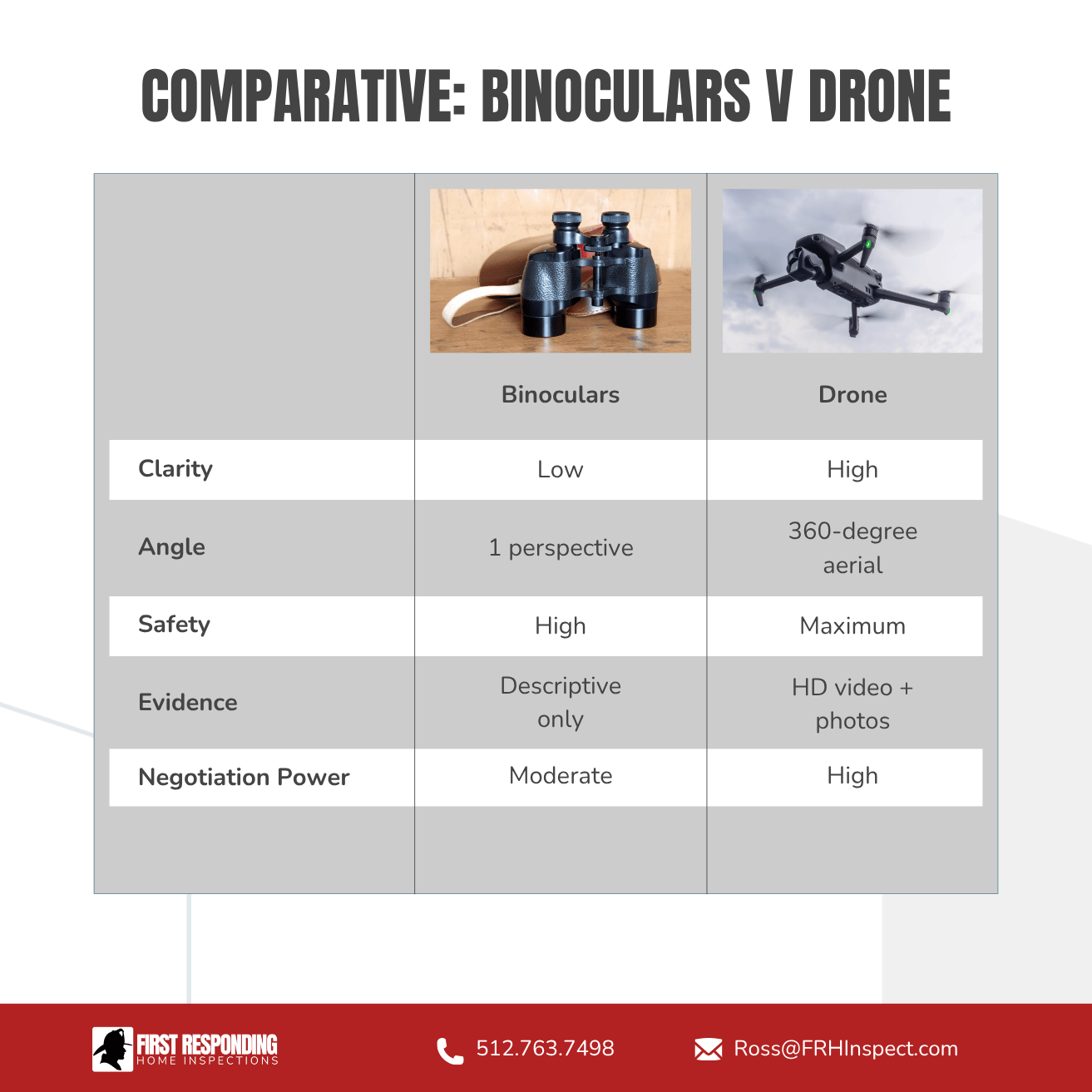
Bluntly put, binoculars are great for bird watching, but they are not top tier for a roof inspection.
What are the main benefits of drone roof inspections?
Using drone technology in a home inspection offers three primary advantages that protect a buyer's investment:
1. 4K High-Resolution Precision
A drone can hover inches away from critical "high-failure" points. My focus is always on the components that lead to the most expensive insurance claims:
Chimney Flashing: The primary source of leaks in Central Texas homes.
Ridge caps: Often the first area to show signs of hail impact or wind uplift.
Valley Sealants: Where two roof planes meet; these collect the highest volume of water and debris.
2. Safety and Property Preservation
A firefighter’s first rule is "Risk versus Reward." Walking on a roof when it isn't necessary can actually damage the granules of an asphalt shingle, especially in the 100-degree Austin summer heat. Drones allow me to document the entire surface with 100% coverage without ever setting foot on a shingle, preserving the roof's integrity.
3. Irrefutable Evidence for Negotiation
In today's buyer's market, you have the leverage to ask for a professional repair list. If my drone footage captures a failing boot or a "bruised" shingle from a previous hail storm, you have a 4K, color-coded receipt to take back to the seller. This is much harder for a seller to dispute than a simple "visual observation" from the ground.
How does a firefighter's perspective improve a roof inspection?
As a retired firefighter, I view a roof as a home’s primary defense system against the elements. My career in the fire service was built on identifying structural weaknesses before they became emergencies.
I bring that same "first responder" mindset to your inspection. I don't just look for "leaks"—I look for the symptoms of systemic failure. Whether it’s an improperly vented gas appliance or a kick-out flashing error that is funneling water into your wall studs, my goal is to provide a non-alarmist, data-driven report that prioritizes your family’s safety.
How can buyers use a drone report to negotiate?
The "Deal-Killer" isn't the defect; it's the unknown cost of the defect. If a roof was "too steep to inspect" by a standard inspector, that represents a massive financial risk for the buyer.
By providing a drone-assisted report, I remove that risk. You can use the findings to request:
Seller Credits: Direct cash off the price to cover future repairs.
Roof Replacement: In many cases, drone evidence of hail damage can trigger a seller's insurance claim, getting you a brand-new roof at no cost to you.
Repair Escrows: Ensuring the work is done by a professional roofer before you move in.
The Bottom Line
Don't inherit a $15,000 problem because your inspector couldn't get a close-up view. Whether I am on a ladder or operating a drone, my priority is ensuring you have the full data set you need to close with confidence.
